|
Spherometer
| A Spherometer is an instrument for measuring the curvature of a surface.
The Spherometer is a device use in measuring the radius of curvature of a
spherical surface. For example, it can be used to measure the thickness of
a microscope slide or the depth of depression in a slide. Even the
curvature of a ball can be measured using a Spherometer.
The Spherometer consists of a micrometer screw threaded into a small
tripod with a vertical scale fastened to it. The head of the screw has a
graduated disk used to measure fractional turns of the screw. The vertical
scale is used to measure the height or depth of the curvature of the
surface.
The vertical scale divisions are on 1 mm, which is the pitch of the
threads of the screw. The head of the screw is graduated into 100
divisions.
|
|
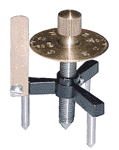
| Aldis's Spherometer
A spherometer is an instrument that
measures the sag of a surface with great precision. A common
spherometer is the Aldis spherometer in which three small balls are
arranged to form an equilateral
triangle. In the center of the triangle there is a probe mounted on a
micrometer. |

Schematic diagram of a spherometer
|
MEASURING THE RADIUS OF CURVATURE BY MEANS OF A
SPHEROMETER
I. Description of the Spherometer
A spherometer is a precision instrument to measure very small
lengths. Its name reflects the way it is used to
measure the radius of curvature of
spherical surfaces.
In general the spherometer consists of:
A. A base circle of three outer legs, a ring, or the equivalent,
having a known radius of the base circle. Note
that the outer legs of the spherometer
shown can be moved to the inside set of holes
in order to accommodate a small lens. This is also trueof the old spherometer in
the lab.
B. A central leg, which can be raised or lowered.
C. A reading device for measuring the distance the central leg
is moved. On the new spherometer, the
vertical scale is marked off in units of
0.5 mm. One complete turn of the dial also corresponds
to 0.5 mm and each small graduation on this dial represents
0.005 mm. The small graduations on the old spherometer are 0.001 mm. See the
diagram.
II. Theory

Diagram for spherometer calculation.
Consider a circle where the distance DE
is a diameter which bisects
the chord AC .
See Figure 2. If we know the distance DBand
BC we
can find the radius of the circle as follows:
From geometry (similar triangles) we have

where R is the radius of the circle as shown in the diagram
III. Measuring the Radius of Curvature, R
The outer (fixed) legs of the spherometer determine the distance
BC .
This is simply the radius of the circle formed by the legs. To
find this radius,
measure the distance from the central leg (when it is coplanar
with the other
legs) to any of the outer legs. This distance is shown in the
schematic diagram
r = BC
The distance BD is
determined from the distance the central leg moves.
First determine the position of the central leg when it is
coplanar with the outer legs by using the
flat provided. (For the new spherometer, a "rocking" technique
is suggested. The center leg of the spherometer is pressure sensitive
and mechanically moves a lever arm that raises a piece of wire.)
Next, find the position of the central leg on the surface being
measured. The difference between these two
positions is the shift of the central leg h which is
equal to DB in
the calculation diagram.
Our equation now reads: R = r2/2h + h/2
|
Distributors of scientific and educational products
Where to buy?
Most pictures are linked to
the pricing and online store for fast and convenient ordering
Our products are available at the following
online stores. For large orders please call in advance and verify the
availability, wholesale discounts and shipping options. If you cannot find any
product in the online store of your choice, please use the search option of the
store or call (973)777-3113 for further assistance.
All orders will be shipped from our
warehouse in United States (USA). We ship worldwide
to most countries including U.S., Canada, Australia, United Kingdom, New
Zealand, Germany, France, Netherlands, and many other countries.
|
|