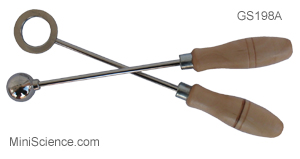
Ball
and Ring Apparatus
Introduction
to Thermal Expansion
Applying heat to an object increases its
temperature. But what really is going on when the temperature of an object
increases?
Temperature can actually be thought of as the
amount of energy that an object possesses. Increasing its temperature will add
energy to the object. When an object gains more energy the molecules inside that
object generally become more excited. This can result in an object vibrating,
glowing, expanding or a combination of all three.
Applying heat to most all solids will result in
some sort of expansion of that solid. The amount of expansion is determined by
the amount of heat applied, the time over which the heat is applied and the
material that is being subjected to the heat.
Different materials will expand at different
rates. This rate is referred to as the coefficient of expansion of that
particular type of metal. For example iron will expand .000012 cm per centigrade
for every cm of length. Therefore irons coefficient of expansion is .000012.
But keep in mind that the material expands in all directions. So not only does
it expand length wise but thickness wise also.
Thermal Expansion
Experiment
| Begin by setting up your heat source
on the table in a secure manner. This heat source can be an alcohol
lamp, torch, hot plate etc. Hold the ball and rod by the wood handle
only. As you place the ball into the heat source the rod can become very
hot. Hold the ring unit by the
wood handle in one hand and hold the ball unit by the wood handle in the
other hand. Without forcing it, slide the ball through the rings
opening. |
 |
The ball and ring set is precision made so
scratching either the ball or the inside of the ring can prevent the ball from
passing through the ring smoothly.
Now begin heating the ball. After about thirty
seconds to one minute of applying heat (This will depend on your heat source)
try gently but quickly sliding the ball through the ring. What happens? You
should find that the ball would not pass through the ring.
Give the ring time to cool and once again try
passing the ball through the ring. As the ball cools you will find that it
reduces in size enough to allow the ball to pass through once again.
Before you perform the next experiment, try
predicting what will happen when the ring is heated up.
Then perform the experiment as before only this
time heating the ring. What happened? Why?
Make sure that both the ring and ball are
cooled to room temperature before putting the set away.
Where to buy Ball and Ring
Apparatus
Ball and Ring apparatus are available in most
scientific suppliers and some museum stores. If you are ordering it online the
product code is usually
BALLRING,
GS198A or LC659. In New Jersey you may buy it from MiniScience in Clifton;
however the best way to order this product is online. You can
Click
Here or any of the images to order Ball and Ring apparatus.
|
Distributors of scientific and educational products
Where to buy?
Most pictures are linked to
the pricing and online store for fast and convenient ordering
Our products are available at the following
online stores. For large orders please call in advance and verify the
availability, wholesale discounts and shipping options. If you cannot find any
product in the online store of your choice, please use the search option of the
store or call (973)777-3113 for further assistance.
All orders will be shipped from our
warehouse in United States (USA). We ship worldwide
to most countries including U.S., Canada, Australia, United Kingdom, New
Zealand, Germany, France, Netherlands, and many other countries.
|
|