Lycopodium powder has numerous commercial uses, some of which are:
Educational use: Lycopodium powder is one of the most popular teaching tools
used to demonstrate dust explosion.
Although, not particularly flammable, when dispersed in air, the surface
area of this powder surrounded by oxigen increases greatly, which allows for
combusion to occur.
Dispersing the powder in the air helps lycopodium to ignite easily and burn
explosively. This is due to its high fact content and large surface area
surrounded by oxygen molecules.
3 Important Uses of Lycopodium Spore Powder
Lycopodium powder is odorless and
tasteless. This powder can float very well in cool water, but sinks in
boiling water.
Popular by its widespread names such as Club Moss, Wolf’s Claw, Fox Tail,
Running Pine, and Lamb’s Tail and native to both North America and Europe,
Lycopodium is simply an evergreen plant, which is used as homeopathic
remedy. Since the middle ages, this homeopathic remedy is usually very
effective for conditions like gout, digestive orders, kidney stones and
water retention. One can find various Lycopodium Spore Powder Suppliers In
UK supplying high grade Lycopodium Spore Powder.
Lycopodium powder has numerous commercial uses, some of which
are:
Educational use: Lycododium powder is one of the most popular teaching tools
used to demonstrate dust explosions. Although, not particularly flammable,
when dispersed in air, the surface area of this powder surrounded by oxygen
increases greatly, which allows for combustion to occur. Dispersing the
powder in the air helps lycopodium to ignite easily and burn explosively.
This is due to its high fat content and large surface area surrounded by
oxygen molecules.
Homeopathic medicine: Lycopodium has been used as a homeopathic medicine
since the middle ages to treat a number of ailments. This homeopathic remedy
is prepared by extracting the pollen from the Lycopodium spores. Lycopodium
clavatum is utilized in homeopathic medicine as a cure for disorders of the
urinary and digestive systems and for liver disfunction. Moreover,
Lycopodium spores can also be employed outwardly for wounds and eczema.
Drying Agent: Lycopodium powder can resist wetting. Hence, it is best
suitable to powder latex surgical gloves in order to make them easier to put
on. It can also be used as a pill coating so as to avoid newly made pills
from sticking together.
So, these are three important uses of Lycopodium powder, which makes this
substance a useful homeopathic remedy.
---------------
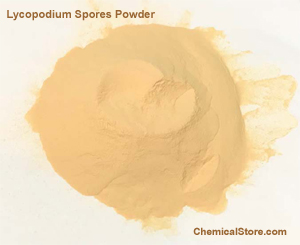
Flash powder:
When mixed with air,
the spores are highly flammable because of their high fat content and their
large surface area per unit of volume — a single spore's diameter is about
33 micrometers (μm).[2] Preferred source species are Lycopodium clavatum
(wolf's-foot clubmoss) and Diphasiastrum digitatum (common groundcedar)
because these widespread and often locally abundant species are both
prolific in their spore production and easy to collect.[citation needed]
Lycopodium has been used in fireworks and explosives, fingerprint powders,
as a covering for pills, and as an ice cream stabilizer. Today, the
principal use of the powder is to create flashes or flames that are large
and impressive but relatively easy to manage safely in magic acts and for
cinema and theatrical special effects. Lycopodium powder is also sometimes
used as a lubricating dust on skin-contacting latex (natural rubber) goods,
such as condoms and medical gloves.[3]
In physics experiments and demonstrations, lycopodium powder is used to make
sound waves in air visible for observation and measurement, and to make a
pattern of electrostatic charge visible. The powder is also highly
hydrophobic; if the surface of a cup of water is coated with lycopodium
powder, a finger or other object inserted straight into the cup will come
out dusted with the powder but remain perfectly dry.
Because of the very small size of its particles, lycopodium powder can be
used to demonstrate Brownian motion. A microscope slide, with or without a
well, is prepared with a droplet of water, and a fine dusting of lycopodium
powder is applied. Then, a cover-glass can be placed over the water and
spore sample in order to reduce convection in the water by evaporation.
Under several hundred diameters magnification, one will see in the
microscope, when well focused upon individual lycopodium particles, that the
spore particles "dance" randomly. This is in response to asymmetric
collisional forces applied to the macroscopic (but still quite small) powder
particle by microscopic water molecules in random thermal motion. The
lycopodium particles appear to be "alive", but they are only inert particles
being buffeted by forces which, again, because of the small size of the
lycopodium particles, respond to the momentum applied to them, which does
not quite average to zero in three dimensions. Thus, the particles move.
As a then-common laboratory supply, lycopodium powder was often used by
inventors developing experimental prototypes. For example, Nicéphore Niépce
used lycopodium powder in the fuel for the first internal combustion engine,
the Pyréolophore, about 1807,[citation needed] and Chester Carlson used
lycopodium powder in 1938 in his early experiments to demonstrate
xerography.[4]
--------------------
Miniscience
produces a wide range of chemicals for research and educational uses. |




